Precision Thinking: How Strong Chess Players Actually Think During a Game
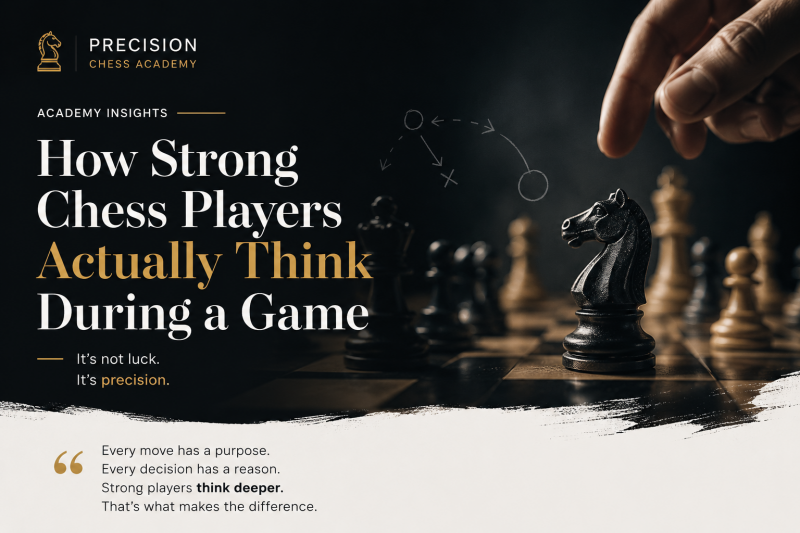
One of the biggest misconceptions about chess is that strong players rely on talent, intuition, or luck. In reality, strong chess players leave very little to chance. Every decision is made with purpose, calculation, and constant attention to detail.
As an International Master and coach, one thing I often notice is that many improving players focus only on their own ideas while ignoring the deeper changes happening in the position after every move. In strong chess, every move matters. A single inaccurate move or blunder can completely change the direction of the game, which is why experienced players are constantly searching for new opportunities and reassessing the position after every turn.
Paying Attention to the Opponent’s Last Move
Strong players are always asking an important question:
“What changed after my opponent’s move?”
Every move creates new possibilities. Sometimes a piece becomes undefended, a square becomes weak, or a tactical idea suddenly appears. Strong players do not play automatically — they constantly adapt to the new position on the board.
This is one of the biggest differences between casual players and advanced players. Strong players are highly alert to changes in the position and are always ready to take advantage of mistakes immediately.
Long-Term Vision Instead of Move-by-Move Thinking
Another major difference is time management and long-term planning.
Strong players rarely think only one move at a time. Their thinking usually begins from the opening and continues with a long-term vision for the entire game. Often, they are aiming for specific pawn structures, favorable middlegame positions, or certain endgames many moves in advance.
This long-term approach helps strong players save time on the clock because their moves are connected to an overall plan rather than isolated decisions.
Keeping the Game Under Control
Strong players always try to keep the “keys” of the game in their hands. They aim to control the direction of the position and keep their opponents under constant pressure.
One common method is creating threats on multiple sides of the board at the same time. When an opponent must defend several problems at once, the chances of mistakes increase significantly.
This is why strong players often appear calm while their opponents feel uncomfortable or under pressure. The goal is not only to find good moves, but also to create difficult decisions for the opponent.
Giving the Opponent Difficult Choices
A very important concept in strong chess is giving the opponent many possible responses to calculate.
When a position becomes too simple or forced, it is often easier for the opponent to defend accurately. Strong players understand this very well. Instead of simplifying the game unnecessarily, they often prefer positions where the opponent has several choices, increasing the possibility of confusion or mistakes.
In practical chess, difficult decisions often matter more than finding the “perfect” move.
Playing Against the Clock
Time pressure is another area where experienced players think differently.
Many beginners play instantly when their opponent is low on time, hoping the pressure alone will win the game. Strong players often do the opposite. They may spend extra time finding the most challenging move possible — a move that is difficult to calculate under pressure.
This forces the opponent to solve complex problems with very little time, often leading to mistakes or time trouble.
Respecting Every Opponent
One of the most important habits of strong players is respecting every opponent regardless of rating, age, or experience.
Strong players do not become careless against lower-rated opponents, nor do they become intimidated by stronger ones. Instead, they focus only on the position in front of them and play against the pieces, not the person sitting across the board.
This mindset allows them to perform at their best without emotional distractions.
Final Thoughts
Strong chess is not about magic tricks or luck. It is about discipline, awareness, calculation, strategic planning, and making practical decisions under pressure.
The stronger a player becomes, the more they realise that chess is a game of constant adaptation and deep understanding rather than memorisation alone.
At Precision Chess Academy, we focus on helping students develop these practical thinking skills through structured coaching, game analysis, and competitive training.